 Ultimate guide
How Do You Organize Care for an Aging Parent?
Last Updated: November 16, 2026
Quick Summary
To organize elderly parent care, start by understanding your parent's real needs through a candid conversation and a written home and daily-activity assessment. Then build a shared caregiver checklist, gather key paperwork, and divide responsibilities clearly among family members.
- Write down which daily tasks your parent manages easily and which have become harder.
- Mark each daily activity as independent, needs some help, or needs full support.
- Keep original legal documents in a fireproof safe or bank safe deposit box, with labeled copies in the home binder.
- Assign each recurring caregiving task to one named owner with a named backup.
- Review the caregiver checklist, medical binder, and responsibility chart in a monthly review.
Table of Contents
- Start With a Clear Picture of Your Parent's Needs
- Build a Caregiver Checklist for Elderly Parents
- Organize Important Paperwork for Elderly Relatives
- Create a Medical Binder and Medication Tracker
- Divide Caregiving Responsibilities Among Siblings
- Manage Finances, Insurance and Care Costs
- Plan for Different Living Arrangements and Care Levels
- Set Up a Monthly Review So the System Keeps Working
- Frequently Asked Questions
Start With a Clear Picture of Your Parent's Needs
Organizing care for an aging parent starts with understanding what your parent actually needs, not what you assume they need. Many families find that a clear, honest picture of daily life makes every later decision easier. This guide focuses on practical home-care organization for families.
The most useful first step is to write things down. Note what your parent manages easily, what has become harder, and where you have been stepping in without a plan. This becomes the foundation for how to organize elderly parent care in a way that holds up over time.
Questions to Ask Your Parent Before Making Any Plans
Start with a conversation rather than a list of decisions. Ask your parent how they feel about their routine, which tasks worry them most, and what kind of help they would welcome. Keep the questions open-ended so your parent stays in control of the discussion.
Useful questions include:
- Which daily tasks take the most effort right now?
- Are there medications, appointments, or bills that feel hard to keep track of?
- Who do you want to hear from first when something changes?
- What matters most to you about staying in your own home?
Listen closely to the answers. Your parent's priorities should shape the plan, even when you see risks they do not.
Assessing Daily Support and Home Safety
Walk through the home with fresh eyes. Look at stairs, lighting, bathroom grab bars, loose rugs, and kitchen access. Note any falls, near-misses, or areas where your parent has started avoiding a room.
Then list daily activities such as bathing, dressing, meals, transport, and housework. Mark each one as independent, needs some help, or needs full support. This simple assessment shows where additional support will make the biggest difference and gives you concrete information to share with doctors or care professionals.
Build a Caregiver Checklist for Elderly Parents
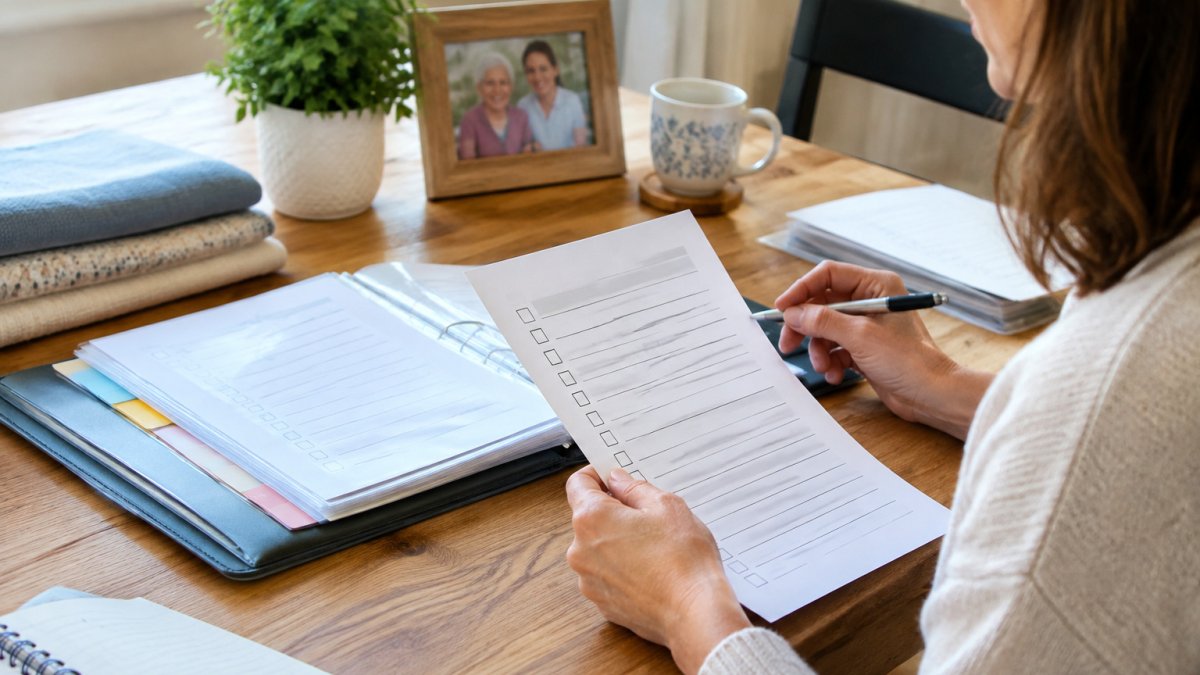
A written checklist keeps care from depending on memory. It also helps siblings, other relatives, and paid helpers understand what needs to happen each week. A good caregiver checklist for elderly parents covers health, safety, household tasks, and personal well-being.

Common items to include:
- Weekly medication check against the current medication list
- Upcoming appointments, transport arrangements, and questions to bring
- Grocery and meal planning, including any dietary limits
- Home safety review, such as checking smoke alarms and clearing walkways
- Social contact and physical activity, which many older adults need for mood and mobility
Review the checklist once a month and adjust it as needs change. A list that matches reality is far more useful than a perfect one that nobody follows.
Organize Important Paperwork for Elderly Relatives
Paperwork tends to become urgent at the worst possible moment, usually during a hospital stay or sudden decline. Gathering key documents early means you can act quickly when it counts. Many families discover gaps only after a crisis has started.
Treat paperwork as three separate layers, because each one is used by different people in different situations. The first layer is identity and access: birth certificate, Social Security card or equivalent, passport, driver's license, insurance cards, and a current list of doctors with phone numbers. The second layer is health and legal authority: advance directive, health care proxy, durable power of attorney for finances, will, and any guardianship or conservatorship papers. The third layer is financial and household: bank and investment account lists, mortgage or lease, utility accounts, pension and retirement statements, and a list of recurring bills with due dates.
Keep the original legal documents in a fireproof safe or a bank safe deposit box, and keep a clearly labeled copy set in the home binder so a paramedic, home aide, or visiting relative can find it without a password. Label the spine and the first page with your parent's name and an emergency contact.
Legal Documents and Decision-Making Authority
Confirm whether your parent has a will, a durable power of attorney for finances, and a health care proxy or advance directive. These documents set out who can make decisions if your parent cannot. Laws on these documents vary by location, so check the requirements where your parent lives and ask a qualified professional to review anything unclear.
Go one step further than confirming the documents exist. For each one, record four facts in your binder: the document's date, who holds the original, who holds a copy, and what specific authority it grants.
Store copies with your records and tell your parent's providers who holds them. Ask each provider to note the health care proxy contact in your parent's file, and confirm that the named person is reachable by phone. Waiting until a crisis to find out who has authority causes unnecessary stress for everyone.
Watch out: a document signed years ago may name someone who has since died, moved away, or become estranged; review the named people annually, not just the paperwork.
Digital Versus Paper Records
Some families prefer paper binders, while others use secure digital folders. Paper is easy to hand to an emergency responder and does not depend on a device or password. Digital files are easier to share with siblings and to update from anywhere. Many families use both: a printed summary kept at home and a secure digital copy shared with trusted family members.
Make the choice deliberately rather than by default. Use paper for anything a first responder or a substitute caregiver might need in the next five minutes: medication list, allergies, emergency contacts, insurance cards, and the health care proxy. Use a secure digital folder for the full record set, scanned legal documents, appointment history, and anything that changes often.
Whichever you choose, write down the access plan. Note who has the password, where the backup copy lives, and what happens if the person who set up the digital folder becomes unavailable. A digital system that only one person can open is a single point of failure, not a shared record.
Create a Medical Binder and Medication Tracker
A medical binder brings together the information a new doctor, hospital, or caregiver will ask for first. Include a current medication list with doses and prescribing doctors, a list of allergies, diagnoses, surgeries, and emergency contacts. Add a short health journal where you record symptoms, changes in appetite or sleep, and questions for the next appointment.
Keep a medication tracker alongside the binder. Note when each medication is taken, and flag any changes made by a doctor. Medication errors are common when several people help with care, so one shared, up-to-date list protects your parent.
Divide Caregiving Responsibilities Among Siblings
Caregiving often falls on one person by default, which leads to burnout and resentment. Sitting down together to divide responsibilities, even unevenly, usually produces a more sustainable plan. This is central to how to organize elderly parent care well, because the plan has to survive real life, not just a single good conversation.
Most families stop at "we'll split it up" and then drift back to one person doing everything. The fix is to make the division concrete enough to be checked. Build a simple responsibility chart with four columns: task, owner, backup, and review date. List the recurring tasks that actually consume time, not abstract categories.
Then assign each row to one named person, with a named backup. A task with two owners usually has none. Match tasks to time, location, skills, and finances rather than to birth order or guilt. A sibling who lives ten minutes away may take the in-person tasks; a sibling across the country may take the phone-based tasks such as insurance calls and appointment scheduling; a sibling with financial experience may take bill payment and account oversight.
Assigning Roles Fairly
Put the roles in writing and review them every few months. Circumstances change, and a plan that worked last year may need adjusting. Share the chart with your parent so they know who is doing what and can raise concerns.
Set communication norms at the same meeting. A common pattern that works: one shared weekly update message covering health changes, upcoming appointments, and anything that needs a decision; a monthly call for the whole group; and an agreement that urgent medical news goes to everyone the same day. Decide in advance how disagreements get resolved, for example by deferring to the person named in the health care proxy on medical questions and to the financial power of attorney on money questions. Writing that down prevents the same argument from recurring every month.
Watch out: the sibling who does the most visible tasks often gets credit while the one handling quiet paperwork and phone calls is overlooked; name both kinds of work in the chart so the load is visible.
Privacy, Consent and Sharing Information Securely
Share your parent's information only with people your parent has agreed to include, and where possible, confirm that consent in writing. Use secure, password-protected tools for digital files, and avoid sending sensitive details through casual text messages. Where a health care proxy or power of attorney is in place, check what those documents permit before sharing records with others.
A practical consent routine helps. Ask your parent once, in a calm moment, which family members may receive medical and financial updates, and note the answer in the binder with the date. If your parent's capacity is changing, revisit that list with a clinician or attorney rather than deciding for them. For digital sharing, use a folder with named access rather than a single shared password, so access can be removed if circumstances change. Keep a short written record of who has been given access and when.
The article suggests a simple responsibility chart so that caregiving tasks are clearly owned and checked.
| Column | Purpose | Example entry |
|---|---|---|
| Task | A recurring job that takes real time | Medical appointments |
| Owner | One named person for the task | Sibling living nearby |
| Backup | A named person who covers if the owner cannot | Sibling by phone |
| Review date | When the assignment is checked again | Every few months |
Manage Finances, Insurance and Care Costs
Money questions can overwhelm families quickly. Start by listing income sources, regular bills, insurance policies, and any existing debts. Identify who has access to bank accounts and who pays which bills, and make sure this is documented and legally authorized.
Review your parent's health insurance and any long-term care coverage to understand what is included. Costs for home help, equipment, and facility care vary widely by region and by level of need, so request written estimates from providers and ask about public support programs available where your parent lives.
Plan for Different Living Arrangements and Care Levels
Care needs change over time, and the right arrangement may change with them. Some parents can remain at home with occasional help, while others need daily support from family, paid carers, or a residential setting. Compare options by safety, cost, distance from family, and how much independence your parent keeps.
Think ahead about triggers for a change. A fall, a new diagnosis, or caregiver exhaustion can each signal that the current setup needs adjusting. Discuss these triggers with your parent and family while everyone can still take part in the decision.
Set Up a Monthly Review So the System Keeps Working
A care system only works if someone maintains it. Set a recurring monthly review, even if it lasts just an hour, to check the caregiver checklist, update the medical binder, confirm appointments, and review the shared responsibilities. Note any changes in your parent's health or mood and raise them with the appropriate professional.
Use the review to celebrate what is working as well as to fix what is not. Organizing care for an aging parent is ongoing, and a steady routine protects both your parent and the people helping them. If you want printable checklists and planners to support this routine, you can browse the shop at Elisa Allender for practical tools you can use at home.
Ready to put these steps into practice? Browse the shop for printable caregiving checklists and organizers that make the routine easier to keep.
Frequently Asked Questions
What should a caregiver checklist for elderly parents include?
A useful caregiver checklist for elderly parents covers daily needs such as meals, bathing, mobility and medication, plus appointments, transport, emergency contacts and home safety items like grab bars and clear walkways. Review it with your parent first so their preferences are written down, then update it whenever their needs change. Keeping it in one shared place, paper or digital, means every family member and helper works from the same information.
What questions should you ask aging parents about their care preferences?
Ask where they want to live if their health changes, which medical decisions matter most to them, who they trust to speak for them, and what daily tasks they still want to do themselves. Also ask about their faith, dietary needs, and how they prefer to receive difficult news. Write the answers down and date them. Revisit the conversation every year or after a major health event, since preferences often shift over time.
How can siblings divide caregiving responsibilities fairly?
Start by listing every task, from driving to appointments and managing bills to overnight help, then sort them by time, skill and distance rather than by who feels most guilty. Assign each sibling a clear role, and be open about what each person can realistically give. Fairness usually means balancing hands-on time with financial or administrative contributions. Revisit the split every few months, because a sibling's availability can change quickly.
What information should families keep in an elderly parent's care file?
Keep a current medication list with doses and prescribing doctors, a list of diagnoses and allergies, insurance details, primary and specialist contacts, and recent test results. Add legal documents such as a power of attorney, health care proxy and advance directives, along with bank and asset account information held securely. Include emergency contacts and a short note on your parent's preferences. Store copies in a locked location and a secure digital folder that trusted people can reach.
How can caregivers keep track of medications and appointments?
Use a single medication list that records the name, dose, timing and purpose of each drug, and update it every time a prescription changes. Bring the list to every appointment. For appointments, use one shared calendar that every family member can see, with notes on what to ask and what was decided. A weekly pill organizer and a simple log of symptoms or missed doses make it easier to spot problems early.
How can you organize a family caregiving team?
Hold one family meeting with your parent present if they are able, and agree on who leads decisions, who handles money, who coordinates appointments and who is the day-to-day contact for paid or volunteer helpers. Write these roles down and share them. A shared group chat or task board keeps everyone updated, and a standing monthly call helps the team handle problems before they grow.
How can caregivers avoid stress while caring for an elderly parent?
Stress drops when tasks are written down, shared and reviewed on a schedule rather than carried in your head. Set limits on what you will do personally, accept help from siblings, friends or professional services, and schedule regular breaks even if they are short. Watch for signs of burnout such as exhaustion, irritability or sleep changes, and talk to your doctor or a support group early if they appear.
Should elderly parent care records be kept on paper or digitally?
Many families use both. Paper works well for signed originals, such as a power of attorney, and for a binder kept at home that anyone can pick up during an emergency. Digital records are easier to update, share with siblings and bring to appointments. Whichever you choose, keep a backup, store legal originals safely, and make sure the people who may need access know where to find everything.